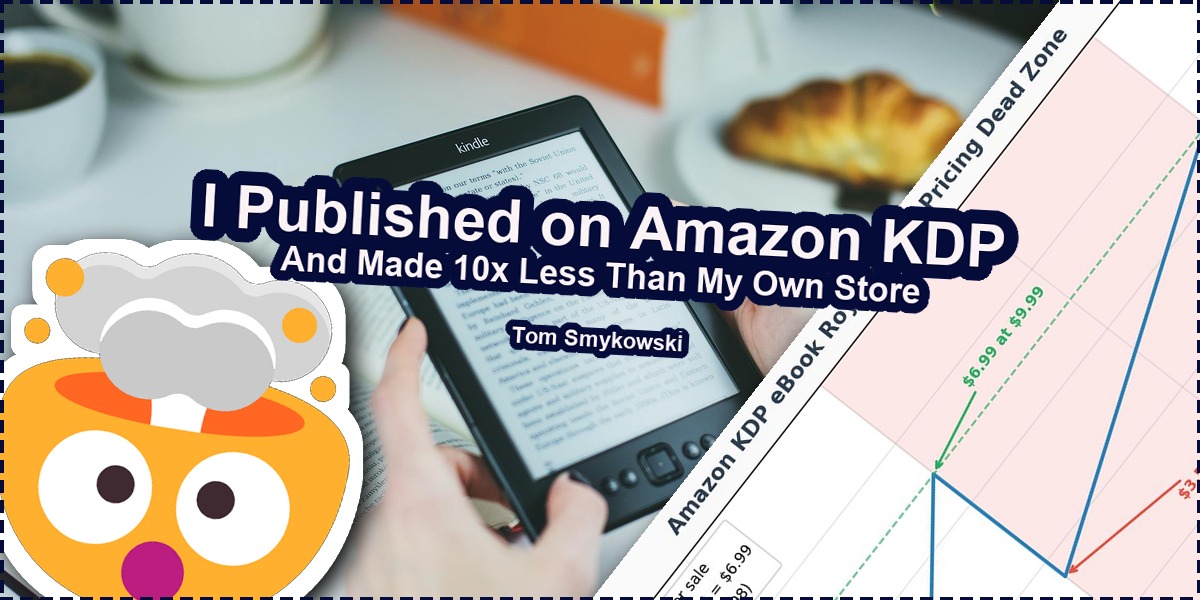
Amazon KDP promises scale and reach that no indie author can build alone. I published a technical book there, tracked the numbers for a month, and the economics told a story Amazon does not put on the landing page. Here is what I learned about royalties, pricing traps, and why your own store might still be the better bet.
Two Books, One Goal
Some of my readers will remember that I published my first book, Vibe Coding Bible, a while back. One buyer described it as the best book on vibe coding they had read. The terminology has shifted since then: we now talk about prompt engineering, agentic workflows, and context management. The principles, though, have not changed, even if the vocabulary warrants a fresh title.
That is exactly why I wrote a second book: Software Engineering for Vibe Coders. I noticed that people who come to programming through AI run into the same problems that junior developers have been hitting for decades. You change code in one place and the entire application collapses. The AI shrugs and says it does not know why. Recent research suggests that companies like Anthropic systematically optimize models to pick the simplest solutions without engaging deeper reasoning. So we have to babysit these bots more than we expected.
I wrote the book from the perspective of someone who has been building and scaling SaaS platforms end-to-end, and who has watched these exact failure modes play out in production. The book captures the guidelines that AI will not volunteer. People seem to appreciate it: it is available as an ebook and, more recently, in print through Amazon KDP.
That last part is the subject of today's article: publishing through Amazon KDP, the royalty structure, what surprised me, and whether I would do it again.
Publishing on KDP Is Not the Hard Part

The actual process of publishing through KDP is reasonably smooth. You upload a manuscript, a cover, fill in metadata, and within a few days your book shows up in the Kindle store.
There are a few caveats to watch out for:
- The ebook format is strict. If your manuscript relies on manual line breaks or spacing, it will fall apart in the Kindle previewer. I recommend creating three test pages and checking the preview immediately. Do not wait until the whole book is uploaded to discover formatting issues
- The cover needs specific dimensions and resolution. Get those specs from the KDP dashboard first and hand them to your designer before any work starts
- Print books (paperback and hardcover) have their own trim size, bleed, and margin requirements. Amazon provides templates, and they work, but each format needs its own layout pass
None of this is insurmountable. It is just the kind of operational detail that eats hours if you are not expecting it.
The Pricing Trap Nobody Warns You About

This is where it gets interesting, and where Amazon's incentive structure becomes pellucid.
KDP offers two royalty tiers for ebooks:
- 70% royalty: available for ebooks priced between $2.99 and $9.99
- 35% royalty: for everything outside that range, including ebooks priced above $9.99
The math creates a trap. At $9.99, you earn $6.99 per sale (70%). The moment you price your ebook at $10.00, you drop to 35% royalty and earn $3.50 per sale. You need to price above $19.98 before the 35% royalty produces more per sale than the 70% tier at $9.99.
That means the $10 to $20 price range is a dead zone. You earn less per sale there than you would at $9.99.
The result is obvious: Amazon is nudging every ebook author toward the sub-$10 price point. For fiction and mass-market titles, that might make sense. For a technical book that took months of engineering experience to distill, $9.99 feels like giving it away.

I ended up pricing my ebook at $6.99 on Amazon. After the 70% royalty and a small delivery fee, I receive roughly $2.45 per sale.
$2.45 Per Sale, No Marketing Budget
To put that in perspective: $2.45 is what I earn from about two articles on Medium. For a book that compresses months of professional software engineering knowledge into a structured guide, written from experience across products scaled to millions of users, the per-unit reward on KDP is sobering.
At that margin, paid promotion does not make financial sense. I tested a few ad campaigns and the numbers did not close. The cost per click ate into the $2.45 faster than sales could compensate.
What does sell copies is personal brand. People in the developer community know my writing from my blog and from Medium. That organic reach drives the KDP sales without me spending on ads. But it also means KDP is not creating new demand. It is capturing a fraction of demand that already exists.
My First Amazon Review: 3 Out of 5
I noticed my first Amazon review arrived. Three stars out of five. I do not know what the reviewer expected or where the gap was, but one data point is one data point. What I do know is that on my own store, the feedback has been universally positive. The audience that finds the book through my channels already understands the context: a senior engineer writing for people building with AI who need the software engineering fundamentals that no LLM will teach them.
Amazon attracts a wider, less targeted audience. Someone searching for "vibe coding" on Kindle might have entirely different expectations than someone who found me through a technical article.
10x Less Revenue Than My Own Store

Here is the number that matters most: in the same time period, my Amazon KDP revenue from this title was more than 10 times lower than what I earned selling the same book through my own store.
The scale effect that KDP promises, where Amazon's massive customer base compensates for the lower margin, has not materialized. At least not yet, not for a niche technical book.

Part of that is structural. Amazon's algorithm surfaces books based on category rankings, reviews, and ad spend. A technical book about software engineering principles for AI-assisted developers is a narrow niche. The algorithm does not know what to do with it, and I am not spending thousands on ads to teach it.
I have been writing about the intersection of AI and software engineering for a while now. When I look at how teams are adopting AI coding tools, the cost is the one thing that consistently surprises people. I wrote a guide on how to reduce AI tooling costs without losing output quality. AI Coding Cost Optimization: Stop Burning Tokens & Credits (2026 Guide) covers model selection, caching, and prompt structure for individuals and teams. Use MEDIUMSAVES20 for 20% off, or subscribe to the Vibe Coding Newsletter for 50% off
What I Actually Wanted from KDP
My main reason for publishing on KDP was not the ebook. It was the paperback and hardcover editions. I wanted a physical copy of the book to exist. There is something about holding a printed version of what you wrote that no PDF can replicate.
KDP Print makes that possible without upfront investment. They print on demand, handle fulfillment, and take their cut. For someone who wants physical copies available on Amazon without managing inventory, it works.
The ebook on KDP was an afterthought. I added it because the infrastructure was already there. Knowing what I know now about the royalty math, I would still publish the print editions on KDP but think twice about listing the ebook there when I can sell it directly for a better margin.
Whether you build products for founders or interview at companies that do, preparation for the technical conversation is always time well spent. I put together React Interview Questions Flashcards so you can review core concepts in a portable, shuffleable format that does not require a screen
Should You Publish on Amazon KDP?
The answer depends on what you are after:
- If you want maximum reach and discoverability for a mass-market title, KDP is probably the right platform. The sub-$10 pricing pressure is real, but volume can compensate if your book appeals to a broad audience
- If you are selling a niche technical book and you already have an audience, your own store will almost certainly generate more revenue per sale and more revenue overall
- If you want print editions without managing inventory, KDP Print is a reasonable option with minimal friction
- If you are counting on KDP's scale to bring new readers, prepare to spend on advertising. The organic discovery for technical books is limited
I treat KDP as a distribution channel, not a business model. The book is there for people who specifically prefer buying on Amazon or who want the Kindle format. The primary sales channel remains my own store, where I keep a much larger share of each sale and have a direct relationship with buyers.
The Real Lesson
The gap between what platforms promise and what they deliver for niche creators is consistent across the industry. Whether it is Medium, Amazon, YouTube, or any other platform, the economics favor either mass-market content or heavy ad spend. If you are a specialist with an existing audience, the platform is a supplement. The foundation has to be something you own and control.
I went into Amazon KDP as an experiment. The experiment confirmed what I suspected: selling through your own store, where you do not give away 30% to 65% of the price to an intermediary, is the better approach for technical authors who have built their own audience.
Will the picture change over time? Maybe. I will keep tracking the numbers and report back if anything shifts. Alon-alon asal kelakon, as they say in Java. Slowly but surely.
If you are exploring AI-assisted development and you want the software engineering foundations that the models skip, Software Engineering for Vibe Coders covers the principles that keep your projects from collapsing when AI picks the lazy path. Also available in print on Amazon
Sources
- Amazon KDP eBook List Price Requirements, official pricing documentation for KDP royalty tiers
- KDP Select Author Earnings report for March 2026: $69.3 million in total payouts (per KDP dashboard)
Related Reading
- How AI-powered ATS systems introduce bias into hiring, on the structural incentives behind automated resume screening and what candidates can do about it
- The future software engineer career roadmap, a longer take on building a career that survives the current shifts in the industry
- Programmers build their own setups to avoid raising AI costs, on why developers are moving away from hosted AI platforms
Have you published a technical book on Amazon KDP? I am genuinely curious whether anyone in the developer community has made the economics work there. What was your royalty split and did the scale actually compensate for the margin? Let me know in the comments.