← Blog

🎮 Will Stop Killing Games Kill Games?

🎮 Will Stop Killing Games Kill Games?
Photo by Tima Miroshnichenko from Pexels

The Stop Killing Games initiative is gaining traction. At its core, the idea is to prevent situations where a great game is just disabled and no one can play it anymore. But will publishers and distributors agree to such a law?

The idea is quite simple: if you publish a game and decide that you won't offer services required to run the game, you're obligated to provide tools for the players to run the game anyways. So basically a game server anyone can run, and no limits to playing the game.

Illustration 1: Gaming controller
Gaming and ownership. Illustration 1: "A person reaching for a game controller" by Tima Miroshnichenko from Pexels, Pexels License

Such a model is popular for quite some time now, and it is technically possible. There are various Minecraft servers, and there's no one kill switch that can disable people playing on various servers. There's a lot more games that support it. And Minecraft by no means is a game that didn't earn money.

So it's not that revolutionary to offer such capability. At least from a technical perspective, because from a business perspective it can be quite confusing for game developers, publishers and distributors. They got accustomed to own the central piece of the game that is the game server and other online services. Thanks to that they can just pull the plug and the game is broken.

The History of Game Ownership

It's not something that was a standard for games for a long time. It's a quite new idea that just got too popular. For years, you were able to play games without even an internet connection. At some point just some companies wanted to offer online services, and because it was cheap, they owned the server exclusively.

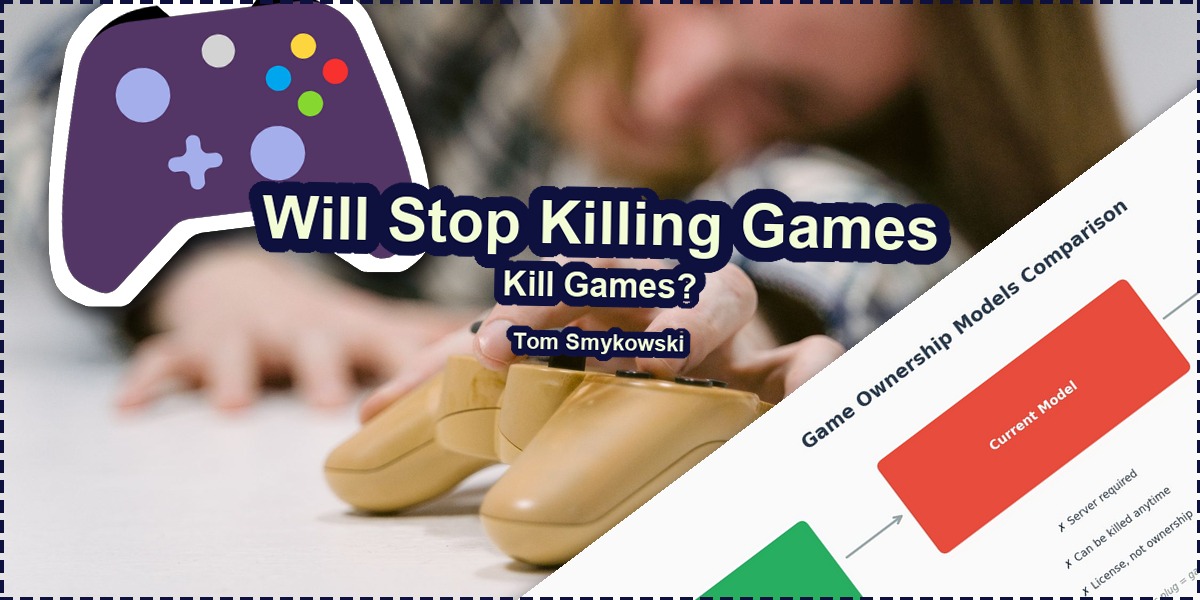
Diagram: Game Ownership Models
Figure 1: Game ownership models comparison. By Tom Smykowski

I get arguments of the players that say that it shouldn't be like that. If a company abandons a game, why players, who paid for the game, shouldn't be able to play anymore. And moreover, I'd say that concerns of studios here are not so great. Because of course we had thousands of games published over the decades, and it doesn't mean people play old games and don't buy new ones.

Who Pays for This?

Illustration 2: Person gaming
The cost question. Illustration 2: "Man holding a game console" by MART PRODUCTION from Pexels, Pexels License

What bothers me is who will pay for that. Companies will try to find a way to earn money anyways. So they'll host the games, or just give away tools to run it by others. But it requires work and may lower income at least in some bellicose minds. It reminds me of how law regulates the market. For example if patent law wasn't enforced, people would just steal patents and earn more money. Patent law is standard for everyone (* - it's better for people with money of course), so companies earn less, but they still earn.

The same way if a law will be enforced, companies will have to adjust. The demand for games won't disappear, so there'll be always a way to earn money. And adding some tools shouldn't be that big of a deal. Just for comparison, we could have thermometers in our smartphones. However producers don't add it, because it costs like 0.10 USD, and they don't see value in it. If law enforced that, we'd all have thermometers in our phones for 0.10 USD. Without regulation, we don't have the thermometers, and if we want, we have to buy a specialised phone that costs several times more than a regular one.

So similarly to games, Stop Killing Games may not cause increase of cost too much.

My Personal Take

Personally I don't play too much games, I play one game, Starcraft II. The online version was made free some time ago by Blizzard, and I just enjoy it. I have also a physical copy I got as a gift. So this problem doesn't affect me at all. But I get that people want to own what they bought.

I think in fact this is not enough. What bothers me also is that people waste money to spend on perks, skins etc. in games. When the game goes offline, they loose all the money. That's also worrysome, and it's really hard to answer what should be done about that.

The Microtransaction Problem

Illustration 3: Couple gaming
Gaming together. Illustration 3: "People playing video games" by MART PRODUCTION from Pexels, Pexels License

But my idea is that if I buy something, I should be able to:

  • Sell it
  • Exchange it

Why not force companies to allow 3rd party and first party marketplace for all things they sell in their games? Personally, for me it doesn't make sense. But if I spent $500 in an online game, I'd want to be able to get that money back by selling items to other players. Here it's more difficult because company wouldn't earn on selling perishable items, but who knows? Marketplaces make markets thrive?

The best way would be to force companies to publish games only if they offer tools to run own servers from day one. And that is something I would vote for. I'd also vote to ban microtransactions. However you think about it, it seems impossible to preserve the value you spend on these. For example you buy 10 additional health points in a game (or whatever), you'll lose them according to game mechanics. You should get refund? No, according to logic of the game, they lost the value.

So the value is gone, and money are gone. It shouldn't work like that. If I buy a house, I lose money, but have house. When I pay electricity bill, I lose money, but I had electricity to for example wash my clothes, so they last longer and I save money on new clothes. So whatever example you take, you lose money, but get something in exchange that is more or less persistent.

Microtransactions often are perishable by default, and because they are, they should be banned. Ok, if you go to an amusement park, and pay for some experience, you don't get anything persistent in exchange. That's true. Maybe it's a matter of distinction. Maybe a game should show info if you can sell/exchange item you microbuy, or not? So that purchasers are aware they lose money permanently?

That's 小確幸 for gamers who just want to keep playing what they paid for. Anyways, I'm for Stop Killing Games movement.

If you're a gamer who also codes, check out the Code Reviewer T-Shirt - perfect for those code review sessions between gaming breaks

AI Coding Cost Optimization - Stop Burning Tokens & Credits
Get the AI Coding Cost Optimization - use code MEDIUMSAVES20 for 20% off

If you're building with AI and want to avoid burning money on tokens, check out my AI Coding Cost Optimization. Use code MEDIUMSAVES20 for 20% off. Subscribers to the Vibe Coding Newsletter save 50%

Sources

Related Reading


What's your take on Stop Killing Games? Should companies be forced to release server tools, or is this government overreach into the gaming industry?

Get the newsletter

Posts and notes straight to your inbox

Get new posts and short notes by email — no spam, unsubscribe anytime.